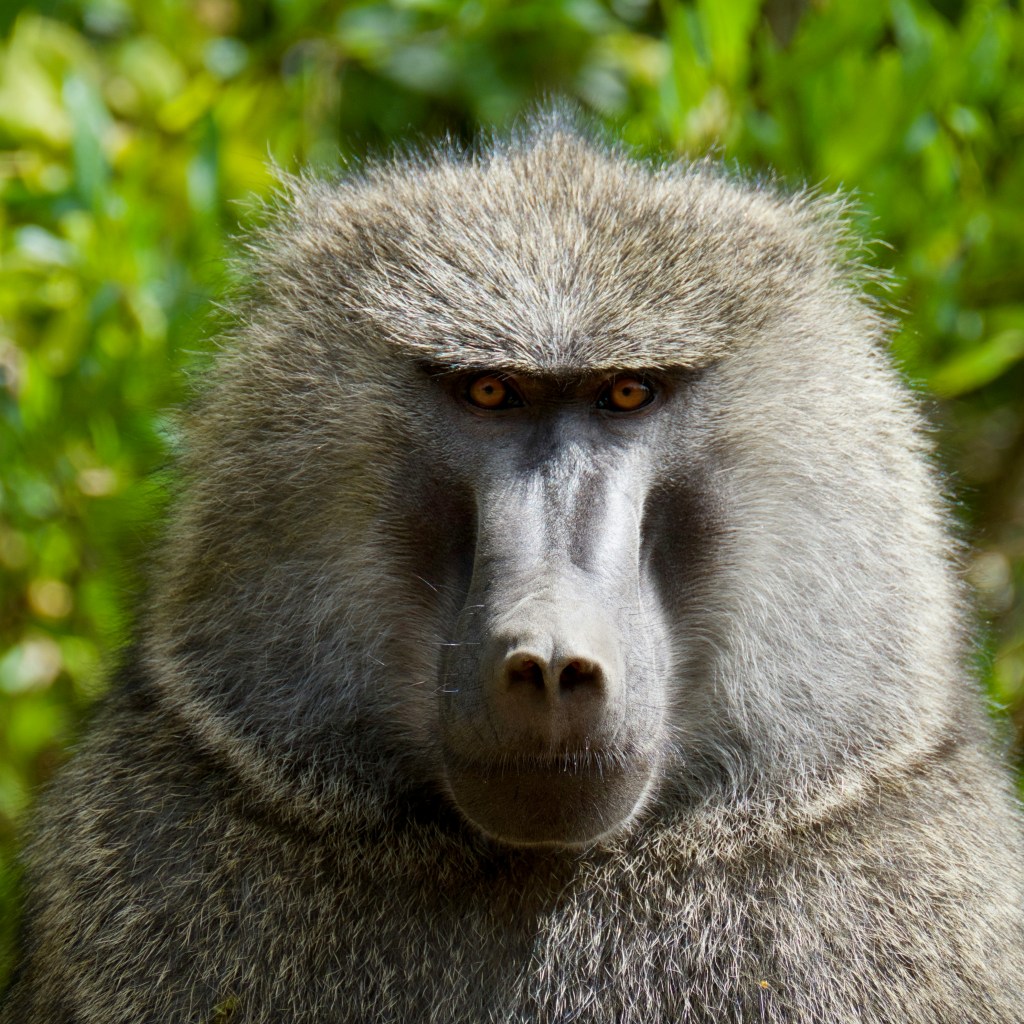
Imagine you’re a baboon. You live in a group of about 50 individuals. You’re digging about by some bushes when you pull out a strange-looking root. You give it a sniff, then you taste it. It’s sweet! You can’t wait to share this new food source with your troop-mates. You’re feeling pretty pleased with yourself when the root is slapped out of your hand. A bigger baboon has snatched it and, perhaps having watched you moments earlier, is now snacking on the root himself.
There’s nothing you can do about it. The other baboon is bigger than you and above you in the hierarchy. All that’s left for you to do is feel bad about yourself.
Basically, it sucks to be a baboon.
And because baboons know a lot about living in groups, having strict hierarchies and having lives that suck, they’re a great candidate to help us learn about how and why we experience psychosocial stress.
Like baboons, humans are a social mammal. Through most of our history we lived in similar-sized groups to baboons. Human hunter-gatherer groups averaged between 25 and 30 members. But like today’s baboons, where groups can reach 250 members, humans might also have been members of groups up to around 200. This was true for most of us until the industrial revolution.
Social dynamics key to psychology
After thousands of years evolving to be safely part of a troop, social dynamics are at the core of baboon psychology. And ours. In any group of baboons, there is a clear hierarchy. The biggest, strongest male at the top. Everyone else below in a strictly defined order of strength. Because these groups are of primary evolutionary importance to baboons, they experience stress relative to how they fit in with their society.
This is great news if you’re a big, strong male baboon. Less good for others. Low-ranking balloons have all the hallmarks of stress that we have when we’re really feeling it. That is: stress related disease. When baboons are small and lack protective allies, they have no control of their position in the hierarchy. This lack of control leads to familiar-sounding health impacts: elevated blood pressure, increased HDL cholesterol, and inability to switch off the glucocorticoid response, which means feeling ‘stressed’ a lot of the time.
The reason baboons make a good model to study psychosocial stress is because social mammals – baboons and us, and others – have essentially the same needs when it comes feeling happy and fulfilled within the group. To feel that they belong, and to feel that they have status. How consistent this status is (eg. does it feel permanent or like it might be snatched away at any moment?) has a big effect on how good we feel. As long as it is moving in a positive trajectory, or staying the same, baboons (and us) feel ok. If our status is threatened, we feel stress.
But we humans have managed to organise groups on a much bigger scale than baboons ever have – from working companies, to fandoms, to nations. What are we doing differently?
We’ve democratised the idea of status
Not many of us expect to be lauded purely for our size and strength. And while the equivalent ‘universal’ marker might be socioeconomic status, many of us lead contented lives without ever getting close to Jeff Bezos wealth.
Note: That’s not to say that we can entirely escape the dominant paradigm of our society. All stress-related disease is dependent on the context of the society it exists in. The most powerful individuals today nearly always have a lot of money, the least powerful very little. Behavioural scientists love to study nuns (and monks in theory, though it often seems to be nuns) because they can ignore the environmental effects of personal choice when studying groups who have lived in the same way and eaten the same things. But curiously, nuns’ long-term health outcomes depend to a statistically significant degree on socioeconomic status at the time they became nuns. So it’s better to think of the subgroups we inhabit as mitigating some of the effects of our global society, rather than completely dispelling them.
Breaking up unimaginably large groups
Our human troops are better understood not as one gigantic grouping, but as lots of self-defined smaller ones. Thus one individual might be of quite low status within her job and her broader friend group, but of high status within a hobby group, with no significant negative impact on self-image.
Such an individual might describe their life thus: “My job pays the bills but my real passion is rock climbing. I’m a member of a group and I coach under 16s. I find it really rewarding to share my knowledge, and climbing provides a group of like-minded friends who also enjoy the physical challenge and being in nature.”
Being a bit more culturally advanced than baboons, we’ve also started to use our groups to gain some control of our stress levels. Some of our collective groups and the activities they involve allow us a controlled ‘dump’ of glucocorticoids (stress hormones), which can make life more tolerable.
Sports help us define our own groups
Being a sports fan is great for this. From this perspective, it’s no surprise that paying to watch organised sport got its start around working-class factory towns. Jobs might be predictable, mundane, lack a sense of reward, while still being stressful – injury or death were common and working conditions were often unpleasant.
Our stress response evolved to help us escape from predators. It’s less helpful when we’re trying to operate with a background hum of low-level stress. So how did we cope with that?
Watching a football match on a Saturday afternoon provides a cathartic stress dump. Win or lose, we know the match will be over after 90 minutes. During that time we have the opportunity to experience a range of emotions more intensely. This intensity often allows us to ‘forget’ our low-level stress, at least for a while.
There are more benefits too. Sharing the experience of being a fan with others, talking about the match and the terrible referee, help reinforce a sense of belonging to the group. Being a long-term fan, a season ticket holder, wearing the shirt and being able to tell stories of the team’s long-ago glories can all increase in-group status.
Activities like being a sports fan have likely ‘evolved’ to help us cope with the fact that we now live in groups that would have been unimaginably large by the standards of 300 or 500 years ago. While these timeframes seem great, in evolutionary terms they’re barely significant.
With this in mind, we would probably do well to avoid treating sports books as just another form of gambling. While many sports gamblers (eg horse racing fans, and those who enjoy sports primarily for gambling) may be able to view the pastime more objectively, there are likely many sports fans who don’t currently gamble for whom the experience of watching sports could be enhanced with a betting aspect.
Understanding these users, their need for belonging and in-group status, and their use of the match as a cathartic ‘stress dump’ will be key.
But betting for fun, with friends, might be something they would really enjoy. After all, not every match is the FA Cup Final or a relegation shoot-out. Perhaps being able to enhance a mundane mid-season match with a few bets among friends might be just what they’re looking for.

 1,001 behavioural insights
Leave a comment