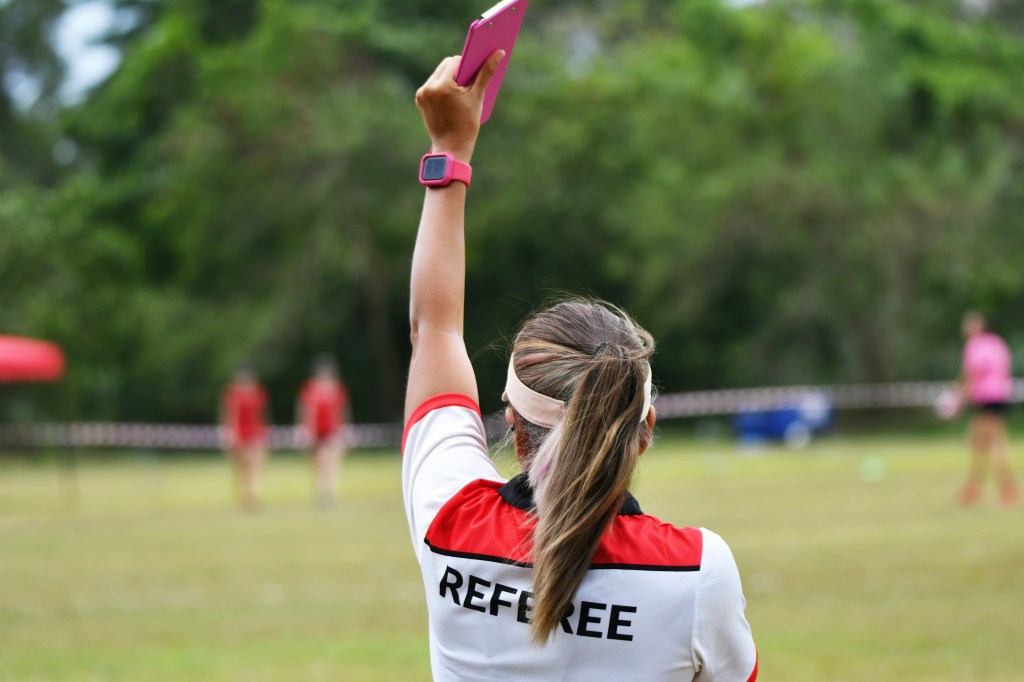
Far be it from me to draw parallels between football referees and crimes against humanity, but European football’s foray into Video Action Replay (VAR) has me thinking about the infamous Milgram Experiment.
The Milgram experiment, named for its author Stanley Milgram, aimed to study the effects of obedience to authority. In the early 1960s, Nazi leaders such as Adolf Eichmann were still being caught and undergoing trial. A common defence offered for committing atrocities was “I was just following orders”. Would people really commit such appalling acts on one another simply because they were told to? Milgram aimed to find out.
The experiment involved an authority figure (apparently a research scientist) asking participants to deliver increasingly potent electric shocks to a second participant (actually an actor). If the participant obeyed all the instructions to increase the potency of the shocks, the experiment would continue to the point where it appeared the second participant (the actor ‘receiving’ the shocks) would ‘die’.
Although the results of the study varied significantly, in many cases, when absolved of personal responsibility for their actions, people like you and me were quite willing to administer what they believed were lethal electric shocks to complete strangers. Just because an authority figure told them to.
Apparently this wasn’t considered when football decided to introduce VAR.
VAR was originally introduced to reduce human error (situations such as Germany vs. England in the World Cup in 2010, where everyone in the stadium watched Lampard’s strike clearly cross the goal line. But the referee and his officials did not).
There are notable process differences between traditional refereeing and VAR.
Traditional refereeing decisions are made on-pitch, by a single individual whose name and face are visible in real-time (perhaps after a short consultation with the fourth official).
VAR decisions give the referee another point of reference. This is made by anonymous video referees who gather and present incident footage from available angles. Still images are created and video of the incident is played at a slower speed. The theory is that the objectivity of the video replay would lead to better decisions. In practice, it hasn’t worked out like this.
But why not?
The fallacy of objective truth
Many of us subscribe to the (patently false) belief that the camera never lies. While video replay technology can help a referee to see an incident that may have been missed amidst the action, the idea that a replay will reveal objective reality as a still image or a slowed-down replay is false. Many times incidents viewed outside of context, or from different angles can look quite different. Ultimately the human being still needs to interpret the incident.
Overreliance on the technology
Referee Donatas Rumsas went to VAR three times in last season’s Champions League match between Copenhagen and Manchester United. As a result of this, he gave two contentious penalties and Marcus Rashford received a red card, In each instance, there was very little expectation either on the pitch or in the stands that a decision should be made. These were marginal decisions that didn’t demand a decision in real-time, but when watched repeatedly in slow motion, they drove the referee to make game-breaking decisions.
Inconsistent application
Different referees are more or less apt to go to VAR. As a result, some games are stopped much more frequently than others, small incidents are more or less likely to be dissected and have an influence on the game. As a result, referees are having a greater influence on the game with VAR.
More disturbingly, we are watching a public experiment in deferring responsibility. Not to an amoral human. But to a machine.
This has more serious implications for society. In recent years, social media has meant that referees are more subjected to abuse than ever before. No one wants to see people subjected to death threats just for doing their job. But the VAR experiment shows that deferring responsibility to a machine doesn’t mean better decision making.
It does give officials the excuse that the decisions made were not entirely theirs.
While the Milgram experiment didn’t show us that most people are mindless automatons in the face of authority (as is often popularly believed), it does show us something about responsibility. That, when faced with enormous pressure, many people prefer to absolve themselves of the consequences of their decision making, even when it means the conclusions they reach are worse.
Making decisions is hard. But we can’t afford to allow poor decisions just to remove ourselves from the firing line. There are areas of life far more important than football where this deferment is creeping in.
In an era where technology is having an increasing presence in our lives, we must use the power this brings to enhance human decision-making. Not to attempt to replace it.
The lessons from history are clear. Nothing good comes where otherwise rational humans stop thinking for themselves and reject responsibility for their decisions.

 1,001 behavioural insights
Leave a comment